




All Hands on Deck: Vincentians at home and abroad must shape the nation’s next chapter.
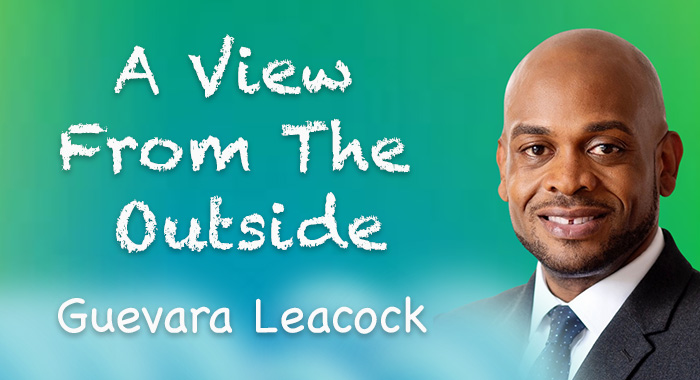
By *Guevara Leacock
On A View from the Outside this week, we turn our attention to the IMF REPORT 2026, with the view being that all Vincentians, at home and abroad, have an opportunity now to rebuild the Vincentian economy. St. Vincent and the Grenadines (SVG) needs all hands on deck.
SVG or Yurumein, as the first peoples who lived on the island between 5,000 and 2,500 years before the present era (BP) called it, stands at an important crossroads. The recently released 2026 International Monetary Fund (IMF) Article IV Mission Report on SVG paints a picture that is both sobering and hopeful.
On the one hand, the country faces serious fiscal pressures such as rising debt, persistent external imbalances, vulnerability to natural disasters and the economic aftershocks of the COVID-19 pandemic and global instability.

On the other hand, the report also identifies areas of resilience and opportunity. Tourism remains strong, the country continues to rebuild after multiple shocks and there is growing recognition that long-term national development will depend not simply on government spending, but on structural transformation, private initiative and national mobilisation.
The central question, therefore, is not whether SVG can recover. The question is, “Who will help rebuild it?”
Increasingly, the answer being proposed by policymakers, investment officials and many commentators is that Vincentians, especially the diaspora, must become active participants in rebuilding the nation of SVG.
The modern rebuilding of SVG cannot be left solely to government ministers or ministries, international institutions, or foreign investors. It requires Vincentians at home and abroad to see themselves not merely as observers of national development, but as co-builders of the country’s future. What this means is that SVG needs all of its people at this watershed period in its history and development. Vincentians, your country needs YOU!
The IMF report is striking because it recognises both the severity of the country’s economic challenges and the importance of structural reforms that encourage productive investment and economic resilience. The report notes that public debt reached 113% of GDP in 2025 and warns that without decisive policy changes, debt could continue rising sharply in the coming years.
We on A View from Outside remind you that the 2026 IMF mission report is reporting on the state of the economy of SVG under the previous Unity Labour Party (ULP) government, so ignore the noise and bias of those who wish to claim and mislead you into thinking that the challenges which the report raises now is the fault of the newly elected New Democratic Party (NDP) government — far from. The new government is fixing the country.
What emerges from the report is an implicit recognition that the future of SVG cannot depend on consumption-driven growth or state expansion alone. Sustainable development will require productive capital, entrepreneurial activity, skills transfer, technological innovation, and stronger domestic economic participation. In a small island developing state, those resources are not found only within territorial borders. They also exist within the Vincentian diaspora scattered across the Caribbean, North America, the United Kingdom and elsewhere.
This is why recent efforts by Invest SVG to engage overseas Vincentians are significant. Speaking in the British Virgin Islands (BVI), newly appointed Executive Director Anna Young rejected the traditional distinction between “home-based Vincentians” and those living abroad. She argued instead that Vincentians overseas must see themselves as part of the nation-building process. Her message was simple but powerful: “We are inviting you to build with us.”
That language matters. It reframes diaspora engagement from sentimental nationalism into economic participation. For decades, Caribbean governments often approached the diaspora primarily through nostalgia, cultural celebration or for remittances. What is emerging in St. Vincent and the Grenadines is a broader conception of diaspora citizenship one grounded in investment, expertise, institutional development, and economic partnership.
Young’s speech importantly recognised that investment is not merely financial. She described investment as “human”, “intellectual” and “relational”. This is perhaps one of the most important insights in the current national conversation. A Vincentian nurse in Tortola, an engineer in Toronto, a teacher in London or an entrepreneur in Brooklyn may possess skills, networks and experience that are as valuable as monetary capital.
Small states often suffer from “brain drain”, but diaspora engagement offers the possibility for knowledge and experience acquired abroad to be reinvested into national development. We on A View from the Outside urge all Vincentians living in the diaspora to take Anna Young’s invitation seriously and get on board to rebuild SVG or Yurumein.
Significantly, the IMF itself identifies areas where the reinvestment of Vincentians in the diaspora can contribute to the development of SVG. The IMF report stresses the need for renewable energy development, modernised education and vocational training, improved business regulation, and expanded digital services.
These are precisely the sectors where diaspora professionals and investors could play an important role. These are also areas of priority for the new NDP government so Vincentians at home and especially abroad should get on board and help the government to build SVG.
The move toward renewable energy is particularly significant. The IMF emphasises that transitioning away from dependence on imported fuel could lower costs, improve resilience, and create employment.
For a country repeatedly exposed to global oil challenges and climate-related vulnerabilities, energy reform is not simply an environmental issue; it is a national security issue.
Vincentians abroad with expertise in solar technology, engineering, finance and green infrastructure, therefore, have an opportunity to contribute directly to reshaping the country’s economic foundations. This is especially important now with the current state of world politics, which is affecting ready access to energy sources, causing soaring prices at the gas pumps and for things like electricity use.
Vincentians have suffered for years with very high electricity costs due to imported fuel. We can fix that with renewable energy reform.
Agriculture presents another area where rebuilding can occur. During the BVI diaspora mission, Minister of Agriculture Israel Bruce emphasised that there are significant opportunities for Vincentians abroad to invest in agricultural production and agro-processing.
In a global economy increasingly concerned with food security, local food production, climate-smart agriculture and regional trade, agriculture can no longer be dismissed as a backward sector. Rebuilding national resilience will require stronger domestic production capacity and deeper integration between Vincentian producers and regional markets.
Rebuilding SVG requires honesty about the scale of the challenge. The IMF report warns that fiscal consolidation is necessary and that expenditure reforms will likely be unavoidable. Practically, this might mean that the government would need to increase taxes, create new taxes or enforce the payment of taxes due. These realities inevitably create social and political concerns.
Vincentians are understandably worried about austerity, rising living costs, and economic uncertainty. This is why national rebuilding cannot be reduced to technical economic management. It must also involve public trust, social cohesion, and a sense of collective ownership over the country’s direction. All Vincentians must feel as if they are involved in the process. We, on A View from the Outside, encourage the government to continue to open dialogue and lines of communication with Vincentians at home and abroad.
The diaspora conversation is even more important. Diaspora investment is not only about money entering the economy. It is also about restoring confidence in SVG itself. When Vincentians abroad choose to invest, build businesses, mentor entrepreneurs, or return home with expertise, they send a broader signal that the nation is worth believing in.
Dr. Adrian Fraser, historian and co-author of the newly published “St. Vincent and the Grenadines – A General History to the year 2025 Volume 1”, reflecting on the IMF report, argues that SVG needs a “home-grown” approach to development that takes the interests of ordinary people into account. That observation is correct. International institutions like the IMF can diagnose problems and recommend policy frameworks, but they cannot create national purpose. Only Vincentians themselves can do that.
The challenge for Yurumein, therefore, is not simply economic. It is psychological and cultural. For too long, many Caribbean societies have internalised the assumption that opportunity exists elsewhere. Migration became not merely a strategy but often a measure of success itself. Yet the current moment invites a different possibility: that Vincentians abroad can remain globally connected while also helping to build locally.
This does not mean romanticising return migration. Not every Vincentian abroad will return permanently, nor should they be expected to do so. But modern nation-building no longer depends exclusively on physical return. Capital, expertise, mentorship, digital entrepreneurship, market access, and institutional partnerships can all flow across borders.
A Vincentian in New York can support business development in Kingstown. A professional in the BVI can invest in agriculture in Marriaqua. A second-generation Vincentian in London can help promote Vincentian creative industries internationally.
Anna Young’s most important statement may have been her insistence that SVG is “one nation, one people, one identity”. In an era of global migration, that vision matters profoundly. It suggests that national belonging is not confined by geography. It also suggests that rebuilding a country is no longer solely the responsibility of those physically living within it.
The IMF report presents difficult truths about the economic realities facing SVG. But crises can also produce moments of national renewal. The country now has an opportunity to rethink development not as something delivered from outside, but as something collectively built by Vincentians themselves. Rebuilding Yurumein will require discipline, reform, innovation and sacrifice. But above all, it will require Vincentians, at home and abroad, to believe that they have both a stake in the country and a responsibility toward it.
Some Vincentians alive today will remember when the IMF visited SVG in 1989 after the first term of the Sir James Mitchell NDP government, which won all 15 seats in 1989. The IMF report said of the Vincentian economy at that time, “Much to please, little to fault”. An opportunity exists now, under an NDP government, to return to that position. On the next IMF visit, the aspiration of all Vincentians at home and abroad should be to hear the Vincentian economy described as “Much to please, little to fault”.
*Guevara Leacock is a barrister at law of Lincoln’s Inn in England and an attorney at law in St. Vincent and the Grenadines. He has a keen interest in history and politics and is a social commentator.
The opinions presented in this content belong to the author and may not necessarily reflect the perspectives or editorial stance of iWitness News. Opinion pieces can be submitted to [email protected].