




The Central Water and Sewerage Authority (CWSA) has announced alternating daytime and nighttime rationing for consumers across a large section of St. Vincent as the drought affecting the country deepens.
At the same time, water distribution continues in the Grenadines, which has no rivers or streams and no municipal water supply and faces a grimmer situation amidst lower rainfall.
The CWSA announced on Sunday that large sections of southern St. Vincent — home to the bulk of the island’s population — will be without water from 10 a.m. to 4 p.m.
This was in addition to the nighttime rationing for resident of a large swath of the southern part of the island, who will see their supply disrupted from 10: p.m. to 5 a.m.
The disruptions come amid the impact of ongoing weather conditions, which have affected river flow and intake into the Dalaway Water System.

“The CWSA encourages persons to activate their Water Storage Systems at this time,” the water supplier said on Sunday.
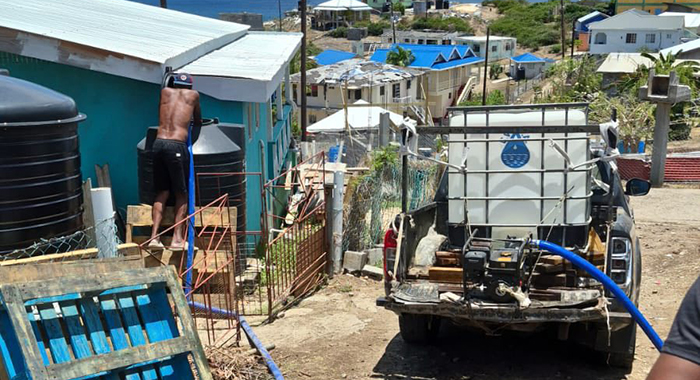
Meanwhile, on Saturday, the CWSA used a local ferry to transport water to the island of the Southern Grenadines, where cisterns have run dry.
The state-owned company used water tanks and pumps mounted on the backs of trucks to deliver water to homeowners’ tanks and cisterns.
The CWSA had urged consumers since mid-January to activate their home water storage plans.
The company noted on Jan. 14 that information from the SVG Met Office showed that SVG had received about 50% less rainfall during the 2025 rainy season than in the previous four years.
The country received just 687.1 mm of rain during the 2025 wet season, compared to 1,552 mm in 2025 and 1,455 mm in 2020.
“With surface and ground water aquifers not fully replenished during the 2025 Rainy Season, it is forecast that the island will be facing the upcoming Dry Season with limited water available, compared to previous years,” the CWSA said four months ago.
The company had said that the situation was especially crucial for communities supplied by the Montreal, Dalaway and Mamoon Water Sources, “as based on our records, they are the first and most severely affected during periods of low rainfall and drought conditions”.
Back then, the Caribbean Climate Outlook Forum’s (CARICOF) had forecast short-term drought conditions for SVG up to March and a long-term drought up to May, CWSA has noted, adding that it might be “forced to adapt and change its
normal operating protocols.
“The rationing of water may start earlier and for longer periods of time, as well as the implementation of stringent water conservation practices,” the company had warned in January.
The rationing began in February, and by the middle of that month, consumers on the Montreal water supply system saw the frequency of their rationing schedule increased to twice daily — from 10 a.m. to 3 p.m. and 9 p.m. to 5: a.m.
By March 2, the CWSA announced that both Mamoon and Montreal Water Systems remained in Level Red, with water rationing for Montreal increased to twice daily.
Dalaway remained at Level Yellow.
Level red is a warning issued by the CWSA when a water system is at risk, and strict water conservation measures are put into place. Car washes, power washing and all other non-essential uses of water should cease completely.
Level Yellow, an advisory, is where a potential risk to the supply is detected. Consumers supplied by the flagged catchment should begin preparing to store water if the alert level increases.
Level Orange, the stage between Yellow and Red, is a “watch” and is declared when a definite risk to the supply is detected. At this stage, consumers should immediately activate water storage measures. Nonessential water use should be reduced.
As Easter rolled around and thousands of people travelled to the Grenadines, the CWSA urged people travelling to the archipelago to carry an adequate personal supply of water.
“This is in consideration of the ongoing period of reduced rainfall being experienced and limited water storage capacity on the islands,” the CWSA had said.
It had noted that “taking along additional water will help to reduce the demand on the limited resources available on the islands and ensure availability for all”.
Meanwhile, on Friday, CWSA noted its January statement, adding that rationing has been in place for months for customers served by the Mamoon and Montreal systems.
“Ongoing monitoring of weather patterns, local climate stations, and river flow data, along with updated reports from CARICOF, confirms that drought conditions are expected to persist across St. Vincent and the Grenadines until the end of May 2026,” CWSA said.
It added that CARICOF had officially placed the country under a drought watch.
“As a result, the Dalaway, Montreal, and Mamoon water sources are under significant stress, with reduced river flows due to decreased rainfall in the upper watershed. This has led to a noticeable shortfall in water supply,” CWSA said.
“Consequently, some domestic and commercial customers, particularly those in the Vermont Valley to Calliaqua (including Largo Height, Green Hill, and Lodge Village), as well as the Marriaqua Valley and surrounding communities, are experiencing intermittent disruptions to their water supply.
“These disruptions will continue until conditions improve,” the company said and urged customers in affected areas to stay informed by following its Facebook page and tuning in to local radio stations for updates and rationing schedules.
The CWSA remains committed to delivering safe, reliable, and affordable water services, and will continue to monitor the situation closely while keeping the public informed,” the company said.
wish you all the best