



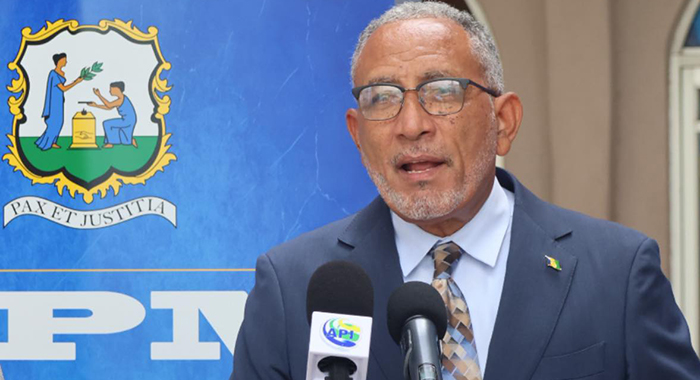

Prime Minister Godwin Friday has announced a set of temporary tax waivers and mandatory discounts on fuel surcharges aimed at preventing steep increases in household and small-business electricity bills, as global oil prices and fuel costs surge.
In a national address on the country’s economic situation and cost-of-living pressures on Wednesday, the prime minister said rising fuel costs for electricity generation were already driving up the fuel surcharge on power bills, and warned that, without intervention, electricity could become “unbearable” for many Vincentians.
“VINLEC fuel expenses have continued to rise steadily, and without intervention, the fuel surcharge would continue climbing beyond the approximately 29% increase already recorded in the first quarter of this year. We cannot allow electricity bills to become unbearable for households and small businesses,” Friday said.
He framed the measures as part of a broader effort to cushion families and enterprises from imported inflation while the government tackles wider fiscal challenges.
Three-month tax waiver on diesel for electricity generation

At the core of the government’s plan to contain electricity costs is a three-month waiver of key taxes on diesel used to generate power.
Friday announced that the government will remove the customs service charge on diesel purchased for electricity generation, and remove excise taxes on the same fuel, for an initial three months.
The prime minister quantified the move as a significant short-term sacrifice of public revenue:
“This measure alone represents approximately $1.65 million in foregone government revenue over the next three months, and these savings will be passed on to consumers.”
Friday said the intent is not to give relief only to the utility company, but to ensure that lower generation costs translate into smaller increases — or even reductions — in consumer bills.
“We… as government are absorbing part of the blow, so that ordinary Vincentians do not have to absorb them all by themselves,” he said.
Mandatory VINLEC fuel-surcharge discounts
Beyond tax waivers, the government is compelling the state-owned electricity provider, VINLEC, to share the burden of high fuel prices with customers by discounting the fuel surcharge once it breaches specific thresholds.
Friday described the approach as one of “partnership and shared responsibility”.
The prime minister said there were two triggers, the first being when the fuel surcharge exceeds EC$0.71 per kilowatt hour, at which point VINLEC must provide a 50% matching discount on the fuel cost formula.
Should the fuel surcharge rise above EC$0.77 per kilowatt hour, VINLEC must provide a 100% matching contribution for households.
“This intervention means relief on utility bills and protection against runaway increases,” the prime minister said.
Protecting households and small businesses
Friday repeatedly linked electricity affordability to the overall cost of living and economic stability, arguing that unchecked increases would force difficult trade-offs for families and threaten jobs in small enterprises.
“It means the difference between a bill that remains manageable and one that forces families to choose between electricity and groceries, both essential,” he said.
He underscored the importance of the electricity measures for a wide range of small businesses.
“And for small businesses, for the barbers, tailors, shop owners, restaurants, bakeries, and small manufacturers and processors, it means protection for jobs, maintaining operating margins, and maintaining affordable prices for their customers.”
By lowering the effective cost of electricity, the government hopes to slow the pass-through of higher generation costs into the prices of goods and services, including food, processed items and services dependent on refrigeration, lighting and machinery.
Push toward renewable energy and regional energy security
Alongside short-term tax waivers and fuel surcharge controls, the prime minister said his administration wants to use the current oil price crisis to accelerate a shift toward renewable energy, particularly solar, as a more sustainable path to lower electricity costs.
“On the energy front, we continue discussions with regional partners through CARICOM, [and] ALBA to secure more stable government-to-government energy arrangements,” he said.
“And we will maintain our 100% tax waiver on solar voltaic systems to help move Vincentians [to] transition towards new renewable energy and lower electricity costs over time. This is a very serious push that our government is engaging with.” [0:26:55–0:27:59]
Friday described the current crisis “as an opportunity, forced upon us, to move aggressively towards renewable energy production, especially solar.
“This will require new ways of thinking about production and sale of electricity. This will require looking at modernising our legislation to accommodate this new thrust.”
He said VINLEC would be expected to play a central role in this transition.
“VINLEC will be required to provide not just partnership but leadership as we go boldly forward in this new direction.”
The prime minister positioned these medium- to long-term initiatives as essential to reducing the country’s exposure to volatile global fuel markets, and thereby to keeping electricity affordable over time.
Broader cost-of-living strategy
The electricity measures were presented as one pillar of a broader 90-day cost-of-living package targeting fuel at the pump, cooking gas, freight charges and food prices.
Friday detailed a three-month intervention on fuel — including cuts to excise tax and a 50% reduction in the customs service charge on imported petroleum products — to prevent gasoline and diesel prices from jumping by more than $5 per gallon.
He argued that moderating fuel costs was directly linked to electricity affordability, given the reliance on diesel for power generation and transport.
That makes no sense. 50% and 100% of what?