



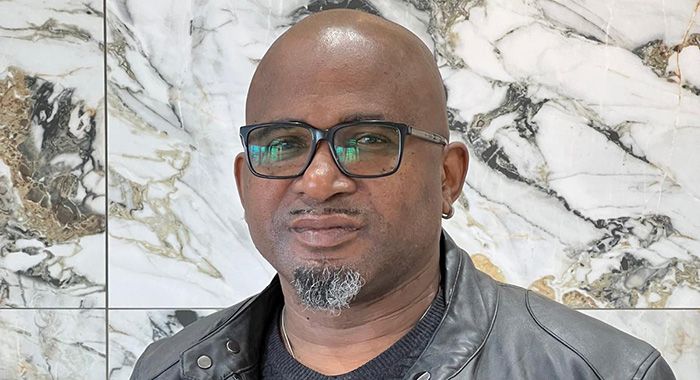

By Marlon Bute
As I looked out across the harbour from my hotel room in Nassau, three football fields away sat the cruise ship terminal.
There were seven cruise ships in port.
They towered above the harbour, their white hulls gleaming beneath the Bahamian sun. Beneath them moved a constant stream of people. Visitors disembarked. Taxis arrived and departed. Tour buses loaded passengers. Vendors prepared for business. The city seemed to move in rhythm with the arrival of the ships.
I was in Nassau attending the Caribbean Postal Union Conference.

My hotel happened to be the British Colonial Hotel. For the record, had I not been visiting as part of a conference and had the hotel not been selected by the organisers, I would not have stayed in a hotel with such a name. Suffice it to say that, as a reparationist, I would not regard it as the ideal venue for a reparations conference.
I was also in the land that gave birth to Sidney Poitier, the first Black man to win an Academy Award for Best Actor. My love for reading had led me years ago to his autobiography, The Measure of a Man. Now that I think about it, it is a book that I ought to reread and one that I would certainly recommend to others.
But I digress.
What captured my attention was the harbour.
At the time, I did not know that the port was managed by Global Ports Holding. Nor did I know that only weeks later the same company would be announced as part of an MoU with the government and people of St. Vincent and the Grenadines about the future development and operation of our own cruise port facilities.
What I did know was that the economic activity unfolding before me was impossible to miss.
Taxi operators earning fares. Tour operators conducting excursions. Restaurants welcoming customers. Vendors making sales. Businesses benefiting from the steady flow of visitors moving through the city.
Meanwhile, there were days when St. Vincent and the Grenadines had no cruise ships at all.
That contrast came to mind as I reflected on three developments over the past week.
The first was the public endorsement by Caribbean Development Bank Vice-President Isaac Solomon of the government’s approach at the Development Partners Round Table.
The second was the announcement of plans to harvest and market aggregate deposits in the Roseau Valley.
The third was the signing of an MoU with Global Ports Holding for the redevelopment and operation of the Kingstown Cruise Terminal.
These developments may appear unrelated.
But they are connected by a common thread.
They suggest a government that is looking to confront inherited challenges not through rhetoric alone but through a combination of honesty, innovation, partnerships, and disciplined management.
That is why Solomon’s comments deserve closer attention.
Development bankers are not known for extravagant praise. Their business is risk assessment, fiscal analysis, project evaluation, and measured judgment. Words are chosen carefully.
Yet Solomon publicly commended the government’s approach, describing the combination of confidence, clarity, and humility as something rarer than it should be. He praised what he characterised as an honest, grounded and analytically rigorous assessment of the country’s circumstances.
Those observations should not be dismissed as routine diplomatic courtesy.
Executives at institutions such as the Caribbean Development Bank engage with governments throughout the region. They hear countless presentations, review countless proposals, and attend countless meetings. For a senior official to publicly single out the quality and candour of a government’s engagement suggests that something about the approach stood out.
Most importantly, Solomon’s remarks suggest that the government was prepared to speak openly not only about its ambitions but also about its challenges.
That matters.
Development begins with an honest understanding of reality. Problems cannot be solved if they are ignored, minimised, or concealed.
The aggregate project reflects a similar willingness to think differently.
For years, an enormous amount of cubic metres of aggregate have flowed from our mountains, down our rivers and into the sea. Worth hundreds of millions of dollars. Today, the process has begun to transform that material into jobs, revenue, and economic activity.
Every road, bridge, sea defence, housing development, and commercial building needs aggregate. It is a resource that stays in constant demand. If managed properly, it can generate employment, support construction, earn foreign exchange and create opportunities in communities that have often struggled to attract investment.
The proposed cruise port partnership reflects the same mindset.
Imagine Kingstown on a bright Tuesday morning a few years from now.
Five cruise ships are in port. The sidewalks are alive with movement. Taxi operators who once spent long hours waiting for a fare are discussing bookings and destinations. One group of visitors wants to see Dark View Falls. Another is headed to the Botanical Gardens. A family is preparing for a trip to Bequia. Vehicles pull away from the terminal one after another, heading north, south, and west.
Along Bay Street and throughout the city, business owners open their doors with the confidence that customers are coming.
A craft producer carefully arranges handmade items beneath a canopy. A restaurant owner glances at a reservation book already filling with lunch bookings. The aroma of roasted fish, fried jackfish, breadfruit and local spices drifts through the morning air.
A young entrepreneur who once ran a single excursion vehicle now owns a small fleet. Another who struggled for years to obtain financing has transformed an idea into a thriving tourism business employing half a dozen people. A vendor who once sold only occasionally now does so full-time and employs others during the busy season.
The benefits extend far beyond Kingstown.
In Marriaqua, a farmer loads produce destined for hotels and restaurants. In Barrouallie, fishers return to shore knowing there are customers waiting. Construction crews are busy expanding guest houses, renovating restaurants, building attractions, and upgrading facilities to meet growing demand.
The young carpenter who once wondered whether he would have to migrate now has steady work. The musician who performed occasionally now earns a regular income entertaining visitors. The craft producer who once struggled to find buyers now ships products abroad to customers first met during a cruise stop.
More money circulates through communities. More businesses expand. More people find work. More families see opportunity where once there was uncertainty.
What is particularly interesting is that the proposed arrangement is not simply about managing a port.
Global Ports Holding has indicated a willingness to provide technical assistance and help in facilitating access to financing opportunities for tourism-related investments.
Naturally, any such arrangement would have to operate within the laws and regulatory framework of St. Vincent and the Grenadines. But the principle is significant.
One of the greatest obstacles confronting many local entrepreneurs is access to capital. There are Vincentians with ideas, ambition and talent who simply lack the financing needed to purchase equipment, expand operations, improve facilities, or launch new enterprises.
If local investors gain greater access to financing, technical expertise and international networks, the benefits could extend far beyond the cruise terminal itself.
More Vincentians could become participants in the opportunities created by a growing tourism sector rather than merely observers.
Equally important, though perhaps receiving less attention, is the government’s stated focus on improving the management of state enterprises and statutory bodies.
New investments and new opportunities are important, but they must be accompanied by the prudent management of the resources already entrusted to us.
Accountability, audits, sound governance, and financial discipline are not bureaucratic exercises. They are essential ingredients of development. Countries do not become prosperous simply by generating revenue. They become prosperous by managing resources wisely, reducing waste, improving efficiency, and ensuring that public institutions deliver value to the people they serve.
I support the efforts of the new NDP administration to address the challenges inherited after many years of ULP rule.
Those challenges are substantial. They cannot be resolved overnight.
But there appears to be a willingness to confront them honestly, pursue innovative solutions and build partnerships capable of unlocking new opportunities for growth.
None of this guarantees success.
The aggregate project must be managed responsibly. The port agreement must be negotiated carefully. Public institutions must become more efficient and accountable. Promises must become results.
But the signs are encouraging.
Construction activity appears stronger than it has been for some time. There is renewed discussion about expanding production and creating opportunities in agriculture. New possibilities are appearing in tourism. There is growing recognition that accountability and efficiency matter.
Taken together, these developments suggest a government prepared to use imagination to find opportunities, partnerships to unlock investment and discipline to improve the management of public resources.
For a small nation facing fiscal pressures, climate vulnerability, and the uncertainties of a rapidly changing world, that is encouraging.
The challenges before us are immense, but they are not insurmountable.
What is needed is vision, determination, sound management, and the willingness to think differently.
The events of the past week suggest that St. Vincent and the Grenadines may be moving in precisely that direction.
The opinions presented in this content belong to the author and may not necessarily reflect the perspectives or editorial stance of iWitness News. Opinion pieces can be submitted to [email protected].