



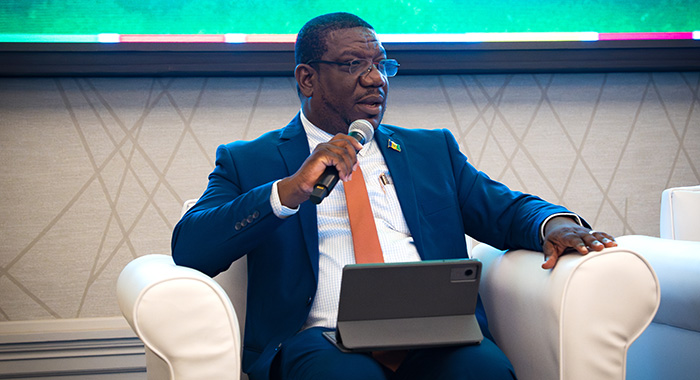

Minister of Agriculture Israel Bruce says St. Vincent and the Grenadines has pushed eight agriculture and food‑system projects into the regional investment shop window.
Two proposals have already advanced into a “deal room” after a high‑level forum in Barbados that focused on mobilising equity capital for Caribbean food security, he told the media on Thursday.
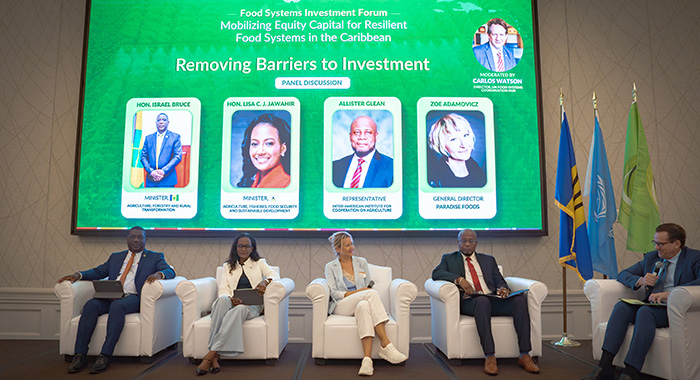
Bruce was part of the Vincentian delegation to the Food Systems Investment Forum in Barbados, where governments, development partners and private financiers met under the theme “Mobilising Equity Capital for Resilient Food Systems in the Caribbean”.
He later held a press conference in Kingstown to detail the projects presented at the meeting and the early signals from investors.
Eight projects on the table

Bruce said SVG carried eight discrete proposals, ranging from agro‑processing and youth investment to irrigation and poultry, into the Barbados forum.
The projects, as outlined by the minister, were:
- A national abattoir project valued at US$5.5 million
- Recapitalisation of VincyFresh at US$4 million
- An arrowroot revitalisation programme budgeted at US$12.8 million
- A “catalysing youth agri investors” project estimated at US$6 million
- A market expansion project for the newly mechanised depots at Lauders, La Croix and Langley Park, costed at US$5.3 million
- A national poultry facility, pitched at about US$5 million
- The Rabacca irrigation project at US$8.28 million
- The Richmond Valley irrigation project at US$2.58 million.
Bruce linked the youth investment component to the budget debate in February, arguing that the country’s farming base is ageing and in need of deliberate generational renewal.
The market expansion project, he explained, is meant to deepen the role of the three upgraded depots on the windward side of St. Vincent as hubs not just for storage and basic processing, but also for reaching new buyers.
Arrowroot, VincyFresh reach ‘deal room’
Bruce said the Barbados process gave each country a narrow window to showcase its project slate to potential financiers.
Out of the eight Vincentian proposals, two – the Vincy Fresh recapitalisation and the arrowroot revitalisation programme – were shortlisted for deeper engagement in what organisers called the “deal room”.
“There are ongoing conversations with the financiers who are in those rooms, and I don’t want to talk outside of school because those conversations are actively in train. We hope that there’ll be fruit borne out of these two deal rooms. We are keeping our fingers crossed,” he added.
Bruce did not name the specific financiers, saying detailed disclosure at this stage would be premature while negotiations remain live.
However, he the selection of the VincyFresh and arrowroot proposals as an early indication that financiers see room for value addition and export growth in Vincentian agro‑processing.
All eight projects placed into regional ‘deal book’
Beyond the two projects that advanced, Bruce stressed that all eight Vincentian proposals have been placed into a regional “deal book”.
This is an investment catalogue that will be used to market projects to potential funders across the Caribbean and beyond.
“Those projects are there in that deal book so that when the Caribbean goes out and [says], ‘These are the projects that we have and we are looking for financing’, that can then go before any investor,” Bruce added.
He presented this as part of a broader regional effort to package agricultural and food‑system investments more professionally, rather than as ad‑hoc bilateral pitches.
Poultry and import substitution
One of the more politically sensitive proposals is the US$5 million national poultry facility, which Bruce has also highlighted in domestic discussions about food import bills and sovereignty.
He said at the press conference that SVG is currently importing “hundreds of millions of dollars of poultry meat” each year and that his government is “laser‑beam focused” on reducing that cost while bolstering local production.
The Barbados forum, he argued, offered one pathway – equity partners or concessionary finance – to move the poultry project from concept to implementation.
‘Grants first’: Bruce outlines funding hierarchy
Bruce used part of his briefing to set out what he described as his personal hierarchy of financing options, saying he is anxious to avoid unnecessary burdens on taxpayers while still accessing capital to modernise agriculture.
The first option is grant funding, followed by public‑private partnerships, then concessionary loan facilities, with general commercial loans as the last option.
He linked that approach to fiscal prudence, casting the search for grants and equity as part of an effort to create “economic ease” rather than additional pressures.
Regional backdrop: resilience, equity capital, food shocks
While Bruce focused on the Vincentian projects, he framed the Barbados meeting in the context of climate‑driven shocks, supply‑chain disruptions and rising food import bills across the region.
The forum, he said, was designed to shift Caribbean agriculture and food systems away from a model heavily dependent on imported food and concessional loans, toward “resilient food systems” backed by targeted equity and blended finance.
From Barbados back to farm roads, youth
Bruce attempted to connect the overseas engagement back to longstanding complaints from local farmers.
“Whilst we were in opposition, the farmers said to us there were three things that were critical to them: one, market opportunities; two, praedial larceny; and three, access roads,” said Bruce, who was among the 14 of the New Democratic Party’s candidates to win a seat in last November’s general election.
“You can see that this mission was focused on market opportunities and access roads,” he said.
In that context, Bruce said the projects pitched in Barbados — especially the abattoir, poultry facility, irrigation schemes and youth investment plan — are meant to be “downstream” extensions of work already underway or promised at home.
‘Fingers crossed’ for concrete deals
Bruce cautioned that none of the projects has yet to secure firm commitments outside Barbados, but insisted that getting Vincentian proposals into the deal room and the regional deal book were necessary early steps.
He promised further updates as negotiations progress, even as he cast the Barbados trip as part of a wider push to court equity, grants and blended finance for agriculture and food‑system projects.
The agriculture minister said these systems are needed if SVG is to move from an ageing, under‑capitalised farm sector toward one that is more youth‑driven, export‑oriented and resilient to external shocks.