



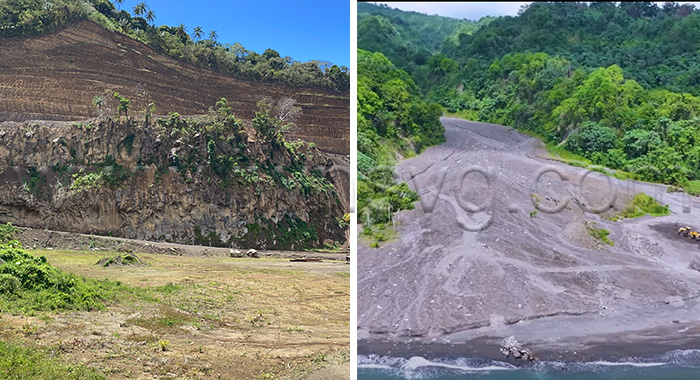

Government ministers and technical officials are insisting that the Roseau River sand and aggregate project is not a repeat of Rayneau’s controversial Richmond quarry — even as North Leeward residents warn that, on the ground, it already feels like “quarry number two”.
At a public meeting in Golden Grove earlier this month, as part of MP Kishore Shallow’s “North Leeward Matters” series, senior officials highlighted key technical and legal differences between the two operations. They said that the sand harvesting operation will involve no blasting, no removal of overburden (topsoil), state rather than foreign control, and a more structured environmental review.
But community leaders and indigenous rights advocates countered that the pattern of late or limited consultation, the concentration of benefits outside the constituency, and the risk to fishing and farming livelihoods closely mirror the Richmond experience under the former Unity Labour Party government in 2022, which they described as a “land grab” and an “environmental disaster”.
MP: ‘We wanted to ensure this is not another quarry project in North Leeward’
North Leeward MP Kishore Shallow framed the Roseau initiative as a deliberate attempt to avoid “another quarry project” like the one at Richmond, which he said has blocked significant development finance.

“What we have done, in a very responsible way, is engage the [environmental] experts,” Shallow, a member of the New Democratic Party government that came to office in November 2025, told residents.
“We wanted to ensure that this is not another quarry project in North Leeward that would certainly interfere with further development, because that is what the quarry is doing now.”
In January 2022, farmers in Richmond were alarmed by tractors moving through their farms.
It later became public that the ULP administration had leased 59 acres of state-owned agricultural land to St. Lucian businessman Rayneau Gajadhar for 30 years to operate a stone quarry.
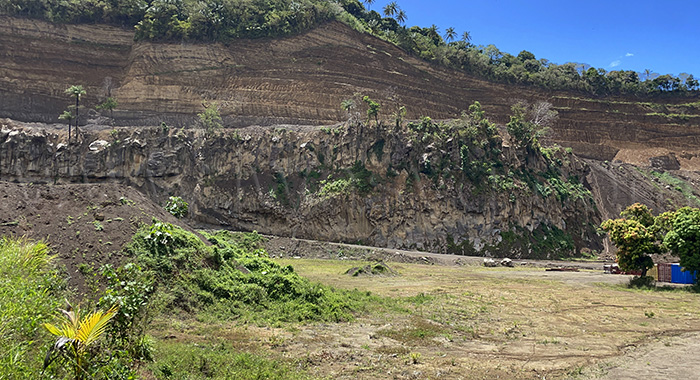
Shallow said the World Bank refused to fund a proposed recreational site in Richmond specifically because of pollution from the quarry.
By contrast, he described the Roseau project as “sand harvesting” that uses natural river deposits, with environmental assessments completed before full operations, and with the government signalling a review of the existing quarry contract.
“I would say to you with a great level of conviction and promise that we are going to address the issue of the quarry, because we are not comfortable with it as well,” Shallow said.
“We have to review the contract… and where there are clauses that permit … us to act, we act, and we have to get an environmental assessment done for that as well.”
‘no overburden, no blasting, no dust situation’
Minister of Health, Wellness, Environmental Health, and Energy, Daniel Cummings, a water engineer, said the Roseau Valley operation is about collecting loose “Rabacca” material brought by the volcano and rivers, while Richmond involves full-scale quarrying.
“You are not going to dig up material and wash it to pollute any river or the sea,” he said.
“The material here was brought by nature, ready… There is no removal of topsoil; it is all ready-to-use Rabacca [aggregates].”
He insisted that Roseau requires no dynamite, no blasting and would produce significantly less dust than Richmond.
“There is going to be no dynamite. There isn’t going to be any blowing up of anything. You’re not going to have the dust situation created. You’re simply taking the materials [sifting them] and getting it out,” Cummings said.
“If it was [otherwise], I wouldn’t be here in this discussion,” the West Kingstown MP said.
He also stressed the difference in export logistics. At Rabacca on the Windward side, rough seas make loading barges difficult. In Roseau, he said, “flat waters” on the Leeward coast allow safer export, opening an income stream that the state says it can reinvest in roads and other infrastructure.
From ‘environmental scars’ at Richmond to ‘minimal disruption’ at Roseau
Minister of Transport, Infrastructure, and Physical Planning, Nigel “Nature” Stephenson, acknowledged that the Richmond quarry has left “pain” and “scars” in North Leeward.
“… it caused the people of North Leeward to be very apprehensive; you still have an issue with trust,” he said
By contrast, he said the Roseau operation will not strip topsoil or clear large swathes of forest and will focus on material already deposited in the river.
Stephenson, who has ministerial responsibility for BRAGSA, the state-owned company that will harvest the aggregates, said that the money generated from the operation will go to the government.
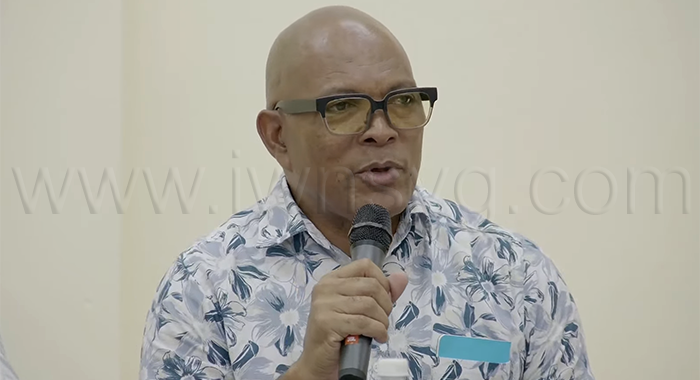
He said stones historically barged out of Richmond were crushed in Grenada and used to build roads there.
“… what is going to be taking place here, any proceeds, any revenue that is derived from the sale of these materials come to the Government of St. Vincent and the Grenadines to be used for the people,” Stephenson said.
“North Leeward will benefit like you have not seen over the past five or even 20 years.”
BRAGSA head: State-led ‘harvesting’ vs foreign-controlled quarry
BRAGSA CEO Kem Bartholomew also drew a distinction between who controls operations in Roseau and who controls the quarry in Richmond.
He repeatedly called Roseau “harvesting” rather than “mining”, and emphasised that a state entity, not a foreign private investor, is in charge.
“We were satisfied that, as a state entity, it is best that we get involved in this operation than any private entity,” he said, explaining why BRAGSA chose Roseau instead of inserting itself into Richmond.
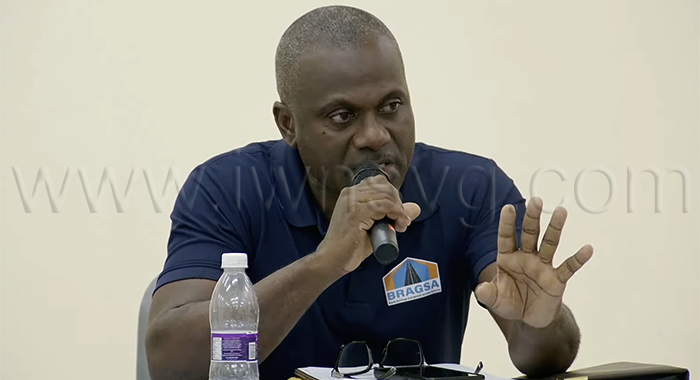
Bartholomew said BRAGSA has approval in principle and an environmental and social impact assessment (ESIA) for Roseau, while activists have long accused the Richmond project of breaching environmental laws and moving ahead without proper assessment or enforcement.
He disclosed that at Roseau, the authority has identified 4.2 million cubic metres of material in a three-kilometre stretch, with potential gross value in the tens of millions of dollars.
Bartholomew insisted that “do nothing is never an option” when that volume of deposit is slowly moving out to sea.
Murray: ‘No overburden, no washing’ — but fisheries risk is real
Environmental consultant Reynald Murray, who prepared the ESIA for Roseau Valley, reinforced the technical contrasts.
He stressed that at Roseau “there is no overburden to be removed”, unlike at a quarry, where topsoil, vegetation, and rock layers are stripped.
“You are not going to dig up material and wash it to pollute any river or the sea,” he said.
“There is no overburden to be removed. There is no blasting to be done. It is simply collecting and [taking] out, and the natural process of replacement.”
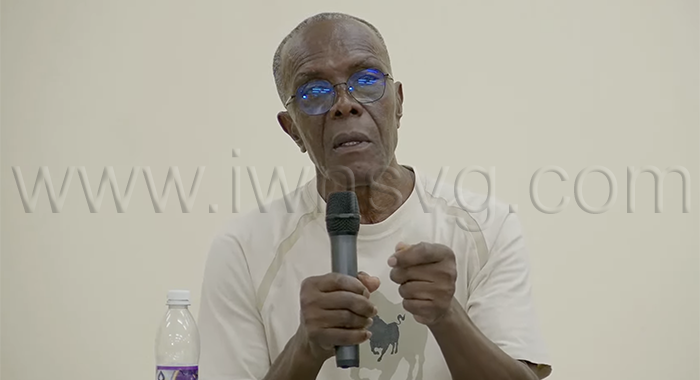
At the same time, he cautioned that the most serious environmental risk at Roseau is to fisheries, not forests or soil organisms.
“All the other things we’re making noise about, we’re making them out of personal or other forces driving us, but the fisheries resource is in fact something that needs consideration.”
Murray contrasted this with Richmond, where residents complain about dust, air pollution, water contamination and landscape degradation on a much larger scale.
Murray argued that Roseau should be managed as a multi-use bay, with co-management arrangements among fishers, tourism operators and BRAGSA, rather than a single-use industrial site as critics say Richmond has become.
Residents: ‘Quarry number two’ in all but name
Despite the official narrative, several residents and activists said that, for North Leeward communities, the lived experience of Roseau so far is uncomfortably close to that of Richmond.
Chairman of the North Leeward Preservation Front, Adonis Charles, said his group had been “very much afraid” that the new administration was “going down the same [road] that the ULP went down” at Richmond, by breaching protocols and starting operations before full consultation.
“We do not necessarily oppose the sand mining,” he said. “What we are talking about is partnership… The Renault quarry is a mess. It is one of the biggest environmental disasters that has been commissioned to happen under the former government.”
He pointed to the lease and agreement for the Richmond operation, which included an annual rent of EC$12,000, and said that every “rule and law” governing the quarry had been broken.
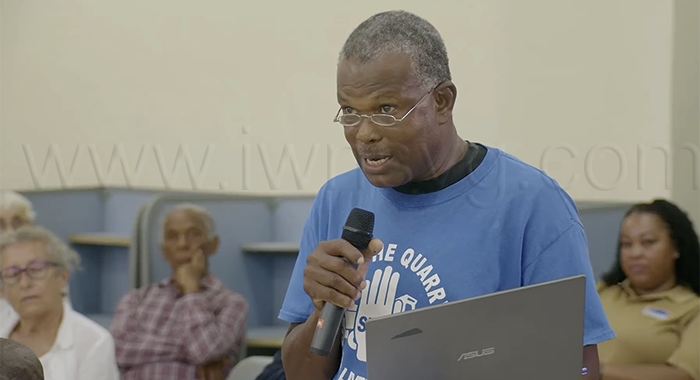
He warned the new government against repeating that pattern at Roseau.
“Don’t get us wrong, we are all for development, but development must be balanced,” Charles said and expressed hope that the meeting was not the final consultation on the issue.
Another activist, Adrian “Tari” Codougan, said calling Roseau “sand harvesting” does not erase how it was rolled out.
“This whole thing was operating before you think about coming to the people,” he said. “Don’t try and come and lecture us like we don’t know anything… We need to participate from the beginning in any form of development that is going to affect our lives.”
Codougan proposed that 25% of net profits from any resource extracted in a community should, by law, be returned directly to that community, arguing that residents have not seen commensurate benefits from either Richmond or the new Roseau project.
Fishers: Volcano, rivers, and a fragile beach
Fisherfolk from the area said that, whatever the technical differences on paper, extraction at the river mouth has direct consequences for their livelihoods and must be considered alongside the impacts already felt in Richmond and from the 2021 eruption.
Officials promise review, residents demand guarantees
Shallow insisted that North Leeward “cannot exist in isolation” from national development, and that the Roseau sand project was a “golden opportunity” that residents themselves had broadly signalled support for — provided that consultation continues and concrete community benefits are delivered.
“This sand harvesting project, it really brings tremendous potential to North Leeward and to Saint Vincent and the Grenadines,” he said.
It is heartbreaking to learn of the exploitation occurring at the Richmond Quarry. For a project spanning three decades, this treatment is a direct insult to the people of St Vincent, who deserve to be treated with dignity and fairness.