




By *Azubah Adams
Every morning, the global tourism engine shifts a staggering amount of humanity. According to the latest UN Tourism data, international arrivals, globally, have roared back to 1.52 billion travellers, completely erasing the memory of pandemic-era lockdowns. However, as global tourism revenue hits record highs, it brings to the forefront a defining question for developing small island states. The question: how do we balance the undeniable economic necessity of increased visitor volume with the physical and social carrying capacity of our local infrastructure?
For decades, St. Vincent and the Grenadines (SVG) was celebrated as the Caribbean’s pristine, low-density, “best-kept secret”. While some regional neighbours built their economies entirely on concrete mega-resorts, SVG as a country remained largely defined by the exclusive isolation of the Grenadines and the untouched, rugged beauty of the mainland.
Today, however, SVG stands at a pivotal developmental crossroad. Tourism officials and policymakers recently celebrated a record-breaking 120,000 stay-over arrivals, driven by expanded international airlift at Argyle International Airport (AIA) and the entry of major international resort chains.
The government’s landmark 30-year concession deal with Global Ports Holding (GPH) to invest up to EC$250 million in the Kingstown Cruise Terminal signals a clear, strategic intent to scale up the destination’s capacity. How does SVG adopt elements of high-volume growth without falling into the infrastructure and social traps of mass tourism (a commercial model centred on moving large numbers of travellers via mega-cruise ships, charter flights, and massive resort chains)? Finding this balance is critical to protecting our national identity.

The policy metric: managing the carrying capacity framework
To evaluate SVG’s current trajectory, sustainable development planners rely on the concept of carrying capacity. This framework defines the maximum number of visitors a destination can accommodate simultaneously without causing severe environmental degradation, compromising local quality of life, or diminishing the visitor experience. This metric is crucial because it acts as the necessary counterweight to the economic realities of mass tourism.
By its nature, mass tourism relies on rapid scaling and economies of scale — large cruise ships, multi-hundred-room hotels, and commercial charter flights — to generate high collective revenue through lower individual margins or head taxes. For a developing nation, the arguments in favour of this pursuit of volume are compelling. It creates immediate, large-scale employment in construction, hospitality, and transport, while generating the foreign exchange required to fund public services.
However, without a strict carrying capacity framework in place, chasing pure volume inevitably triggers a tipping point.
When numbers become the only measure of success, the infrastructure designed to handle those arrivals begins to fracture. The modern regional conversation has, therefore, shifted away from how many tourists a country can attract, toward a more precise calculation: how effectively can an island’s infrastructure absorb the physical friction of those high-volume arrivals? When this calculation is ignored, destinations quickly experience the severe economic and social strains felt across the Caribbean today.
Regional slants: The Caribbean tipping point
We do not need to look across the Atlantic to see the consequences of exceeding carrying capacity; the Caribbean provides a vivid spectrum of models and outcomes.
- The High-Volume Strain (The Bahamas & St. Maarten): Destinations dependent on high-density arrivals face relentless structural pressure. When multiple mega-ships dock at once, thousands of visitors instantly flood localised hubs. While head taxes accumulate, the associated costs of road maintenance, waste management, and public safety place a heavy, permanent burden on municipal budgets.
- The social friction (Jamaica): Decades of prioritising multi-thousand-room all-inclusive resorts have created complex social tensions regarding beach access. Data highlighted by the Jamaica Beach Birthright Environmental Movement (JaBBEM) notes that less than 1% of Jamaica’s shoreline remains freely accessible to the public without cost, due to extensive private coastal development.
SVG has already navigated the early sparks of this tension within our own archipelago, notably through past discussions regarding community access corridors in Canouan. As the mainland expands its room stock, policymakers face the delicate task of protecting Vincentians’ constitutional right to enjoy their coastlines, ensuring locals never feel like second-class citizens in their own country.
The economic equation: leakage vs. linkage
Another critical pillar of this discussion centres on “economic leakage” — the percentage of tourist dollars that leaves the destination country to fund foreign corporate profits, international food supply chains, and foreign-owned management.
“Tourism leakage in the Caribbean is estimated to be at an astonishing 80% of visitor expenditure”. This is according to Charles “Max” Fernandez, Antigua and Barbuda Minister of Tourism and Investment.
Since small island states often lack a robust domestic manufacturing base or the commercial agricultural capacity to feed thousands of transient visitors daily, a significant portion of every dollar spent can leak back to foreign hubs.
The policy challenge for SVG, therefore, is structural. If we scale up to a mass tourism model, we must simultaneously scale up our domestic agricultural, cultural, and fisheries linkages. Otherwise, the nation risks absorbing 100% of the ecological wear and tear while retaining only a fraction of the actual wealth generated.
The maths of the strain: resource infrastructure
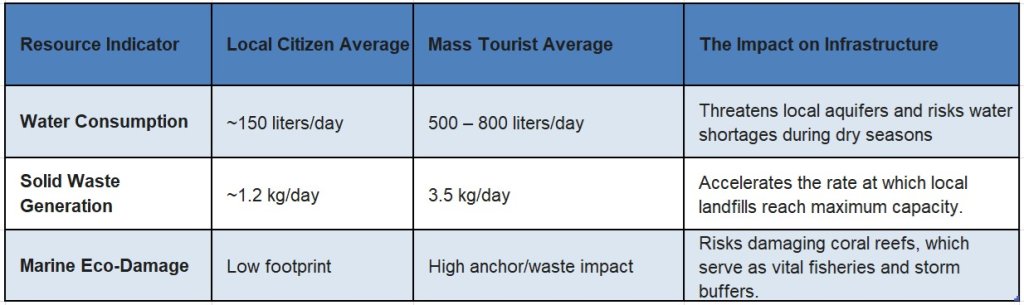
When a next-generation cruise ship docks in Kingstown, the immediate economic injection to taxi drivers, vendors, and tour operators is vital. However, managing the physical footprint of thousands of arrivals in a single afternoon requires careful mathematical planning to protect our natural assets:
The vision: aligning volume with resilience
As SVG actively navigates a complex economic path — moving past the lingering scars of the La Soufriere volcano eruption and the devastating wake of Hurricane Beryl — our primary national goal must be structural resilience. In a climate-vulnerable archipelago, chasing high-volume mass tourism cannot simply be about driving short-term GDP metrics; it must be treated as a high-risk development model that demands immediate domestic shock absorbers. If we are pouring concrete to expand capacity, that growth must directly insulate our islands from the next inevitable ecological crisis.
Therefore, the ultimate objective of managing our tourism sector must shift away from tracking raw passenger numbers toward a strict “value over volume” strategy. Regional neighbours like Dominica, with its “Nature Island” branding, and Bonaire, with its strictly protected marine parks, have carved out highly lucrative economic niches by deliberately restricting large-scale mass developments. They have proved to the global market that modern travellers are willing to pay a premium for pristine, uncrowded, and ecologically preserved environments.
SVG has a rare, golden opportunity to forge a definitive middle path between these two Caribbean extremes. We do not have to choose between the heavy structural strain of high-density cruise hubs and the complete economic isolation of untouched eco-islands. Instead, by aggressively channelling national tourism revenues—derived from expanded international airlift and modern transport hubs — directly into funding local agricultural cooperatives, protecting traditional crafts, and enforcing strict marine conservation, SVG can build a uniquely resilient model. The tourism engine we construct must be designed to lift our people, diversify our domestic economy, and ensure we never wear down the island’s natural defences.
In my previous piece, I summarised a guest lecture presented at Monroe College: “The agri-tourism-hospitality nexus: shaping the modern guest experience”.
*Azubah Adams is a hospitality and tourism development professional with a keen interest in sustainability.
The opinions presented in this content belong to the author and may not necessarily reflect the perspectives or editorial stance of iWitness News. Opinion pieces can be submitted to [email protected].
AI slop in a sustainability piece? iconic!
For those of you who don’t know, AI is a tool designed to assist you in working out your ideas. The operative words here are “your ideas”, not AI’s ideas.
Let’s be clear. There is no “undeniable economic necessity of increased visitor volume.” Simply Increasing the sheer number of visitors does not necessarily have any positive economic impact or any other positive effects. What may have a positive economic impact is increasing visitor spending, but only if the increase in spending more than pays for the numerous associated increased costs linked to supplying water, taking care of waste management, etc., etc. Some costs associated with increased visitor volume, such as damage to our vulnerable special places like the Tobago Cays cannot be paid for by increased visitor spending and may in fact be irreversible. From what I’ve seen, our new Tourism Authority CEO understands this, unlike some of her predecessors who tended to focus, at least publicly, on arrival or stay-over numbers, which are – at best – process measures and certainly not valid measures of the outcomes we should be seeking.