



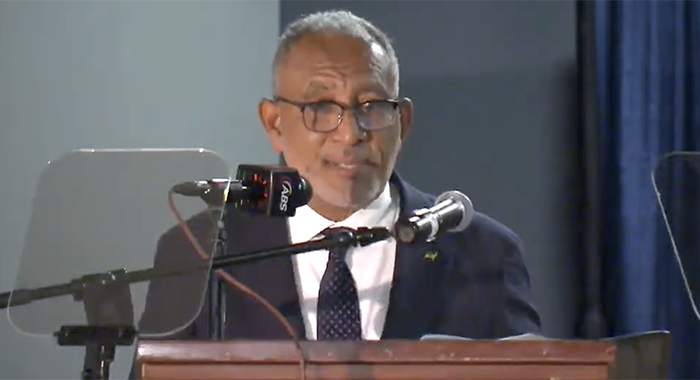

ST. JOHN’S, Antigua — Outgoing Organisation of Eastern Caribbean States (OECS) Authority chair and Prime Minister of St. Vincent and the Grenadines, Godwin Friday, has urged Eastern Caribbean leaders to treat regional integration as a practical tool for survival in an increasingly hostile world, warning that small states “cannot afford to be slow to act when the world is moving fast”.
Speaking at Sunday’s opening of the 78th Meeting of the OECS Authority, Friday framed his brief tenure as chair around a simple conviction: that service to the regional project is inseparable from service to his own citizens.
“The things that my people at home call for, our small island developing country cannot achieve by itself, but must work together with other neighbours to make them happen,” he said.
“So, in serving the OECS well… I know that simultaneously I’m serving the interests of the people of Saint Vincent and the Grenadines.”
He handed over the rotating chairmanship to Antigua and Barbuda Prime Minister Gaston Browne, saying Browne would inherit ongoing work on air transport, energy security, development finance, and a coordinated response to sensitive security and migration demands from larger powers.

Managing ‘two hefty roles’ amid geopolitical shocks
Friday reminded the audience that he assumed the OECS chair at the same time he became prime minister of St. Vincent and the Grenadines about seven months ago, describing them as “two inheritances on a single day”, echoing earlier remarks by OECS Director General Didicus Jules.
He said the dual responsibilities turned out to be complementary, not competing, as domestic priorities like energy affordability, air transport and climate resilience can only be effectively tackled through regional cooperation.
Friday placed his chairmanship in what he called “a time of profound geopolitical uncertainty”, arguing that global tensions in the hemisphere are reshaping the region’s security, energy costs, migration flows, and diplomacy.
“What may be mere tremors for large nations are experienced as earthquakes by us small island developing states,” he warned. “We therefore suffer the consequences most and for the longest.”
Coordinated response to US request on third-country deportees
One of the most delicate issues during his tenure, Friday said, was a request from the United States for OECS countries to accept persons deported from the US who are not their own nationals.
He called it “a delicate and serious matter” with implications for security, scarce public resources and sovereignty, and said OECS members deliberately chose a collective approach rather than navigating the issue in isolation.
“We are still working through this matter very carefully, because it holds serious implications for our economy, the safety of our people, utilisation of scarce resources, and for sovereignty.”
In response, he said, OECS leaders agreed to negotiate together and to build a joint technical mechanism.
Friday presented this as proof that sovereignty and solidarity can reinforce each other, not cancel each other out.
“We can work very closely together for each other’s benefit,” he said.
From ‘two meetings a year’ to responding at the ‘speed of events’
Friday said the OECS Authority changed its own working rhythm during his chairmanship to match fast-moving external developments, moving beyond the treaty’s requirement for two meetings a year.
He recalled that the authority met in Saint Lucia in January, then again in a a special session in March, and maintained a series of virtual meetings to ensure coordination.
“We act upon the knowledge that a small region cannot afford to be slow to act when the world is moving fast,” Friday said.
“And so we resolved to be quick, to be coordinated, and to keep our people informed, to assure them honestly and often that we work for decisions that are in their best interest.”
Energy, EU proposal and alternative development finance
Friday said a central focus of the authority under his chairmanship was to use sovereignty and influence “strategically” to secure larger development gains than any single OECS state could access alone.
He pointed to ongoing engagement with a European Union proposal for a regional energy and digital connectivity initiative, involving an Eastern Caribbean energy grid and submarine cables to link geothermal, solar and wind resources.
He said the initiative could help ease “enormous fuel bills” and, over time, potentially allow the region to export clean energy, but he also underlined fiscal prudence:
Friday also referenced work on “integrated finance-ready portfolios” and new instruments that treat natural capital and resilience investments as economic assets to broaden access to development finance.
Air transport crisis and push for a jointly owned airline
On the long-standing air connectivity crisis following the collapse of LIAT, Friday said the OECS Authority moved “from lament to plan” on a jointly owned regional airline, but acknowledged that critical decisions still lie ahead.
Friday linked reliable, affordable air transport directly to political and economic integration, reinforcing his argument that the OECS must “redouble” regional efforts.
Canada partnership, labour mobility and CBI regulation
The outgoing chair said his tenure also included efforts to modernise and strengthen the partnership with Canada, focusing on climate resilience financing, sustainable energy, food security and cooperation against transnational crime.
Friday highlighted labour mobility arrangements and citizenship by investment (CBI) regulation as areas where regional work continued “steadily, if sometimes quietly”.
He stressed the importance of an independent regional authority to regulate CBI programmes, echoing concerns raised across the Caribbean and in partner capitals.
“While we have our challenges, progress is being made. We can do better, however.”
Movement of goods and ‘contingent rights’ lagging
Friday acknowledged significant unfinished business in the OECS Economic Union, noting that the region has had free movement of people for more than 15 years, while regimes governing goods and citizens’ rights remain incomplete.
He said transportation remains “too expensive and too unreliable”, with obvious consequences.
“The effects of this problem are obvious and damaging, both politically and economically,” he warned.
Despite the gaps, Friday defended the continued relevance and value of the OECS project.
“The enthusiasm of earlier years may have dimmed somewhat, but we must never doubt the enduring appeal and relevance of the organisation. Our neighbours see it, and many wish to join or to intensify their relationship,” the Vincentian leader said.
“It is therefore necessary, and beyond that, it’s desirable that we redouble our efforts to make this project work,” he added.
“We do so because of the many benefits it brings to us now, and the greater benefits that it can bring in the near future for our people.”