




St. Vincent and the Grenadines has stepped onto a larger global stage in the climate crisis, joining the Climate Vulnerable Forum (CVF) with a pointed appeal for fairer financing and stronger recognition of the existential threats facing small island states.
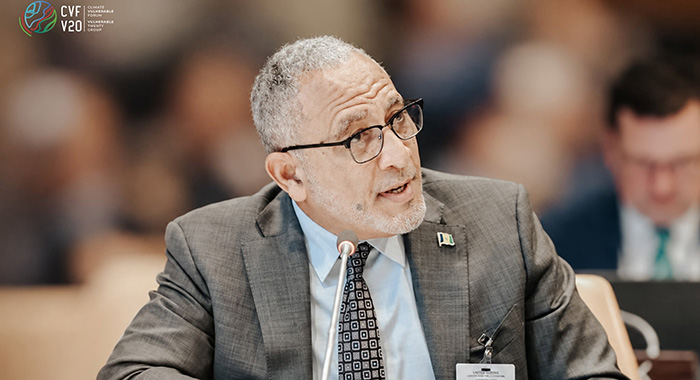
Speaking at the CVF high-level event titled “Climate Vulnerable Forum”, in New York, Prime Minister Godwin Friday framed his country’s entry into the coalition not as a plea for charity, but as an assertion of justice from “the front lines” of climate impacts.
He addressed fellow leaders after interventions from Sierra Leone and Rwanda, both of which had underscored how climate change is eroding development gains and driving up the cost of borrowing for vulnerable countries.
Friday thanked CVF Chair, Prime Minister Mia Amor Mottley of Barbados, and Abdulhamid Alkhalifa for their leadership in advancing the forum’s work.
He said SVG was not merely seeking to benefit from a new platform, but to contribute lived experience to what he described as “this common struggle for human survival and economic equity”.

That experience, he reminded the room, is stark, noting that SVG is still reeling from the impact of Hurricane Beryl, which “destroyed a section of our country where destruction was total” on July 1, 2024.
The country is also recovering from the explosive eruption La Soufriere volcano, which struck in April 2021, while the nation was already in a state of debt distress.
These overlapping disasters, he suggested, are emblematic of the broader dilemma facing climate-vulnerable states: they are forced to borrow on expensive, often commercial terms to rebuild from losses they did little to cause.
Friday used SVG’s accession to the CVF to sharpen a critique that has become central to the forum’s advocacy: that the current international financial architecture remains structurally unfair to climate-vulnerable economies.
He singled out “outmoded middle-income metrics” which, he argued, continue to deny small island developing states access to concessional finance, even when their exposure to climate disasters is severe.
As a result, governments are pushed towards borrowing at high, sometimes “punitive” rates to repair damage driven by global emissions.
Aligning SVG squarely with the CVF’s reform agenda, Friday backed calls for a fundamental rethinking of how climate-vulnerable states are funded.
He argued that “critical investments in water security, schools, resilient healthcare” and other pillars of sustainable development “cannot depend on short-term, essentially punitive debt.”
Instead, he endorsed a shift towards long-term instruments, suggesting 40-year terms where possible, with borrowing rates priced below the national economic growth rate, allowing countries to invest in resilience without being trapped in cycles of unsustainable repayment.
SVG’s decision to join the CVF comes as the forum pushes a package of initiatives designed to turn that critique into concrete mechanisms.
In New York, leaders were working to secure agreement on the CVF Leaders’ Declaration and advance the drive for United Nations observer status, a step that proponents argue would give the coalition a stronger voice in multilateral climate and finance negotiations.
Within that framework, Friday announced SVG’s full support for two flagship instruments: the Vulnerability to Viability (V2V) Compact and the Lifeline Fund.
The compact, already welcomed by leaders such as Sierra Leone’s President Julius Maada Bio, is intended to place vulnerable countries in the lead while urging international financial institutions to align with their nationally defined investment platforms.
The Lifeline Fund, whose governing instrument SVG fully endorsed, is designed to provide fast, predictable finance without the burdensome conditions that often slow or complicate access to climate-related resources.
For Friday, these innovations are not abstract policy tools but potential lifelines for countries like SVG.
He cast the development shift led by the CVF as a “development reset” that must “replace fiscal depletion with durable prosperity”.
The entry of SVG into the forum, he suggested, is part of a broader effort to ensure that climate-vulnerable states are not consigned to permanent reconstruction and repayment, but are instead equipped to build resilience and long-term stability.
Throughout his intervention, the prime minister reinforced one of the CVF’s core messages: that the 1.5 degrees Celsius global warming threshold remains a red line for small island developing states.
“Complacency regarding temperature overshoots must be rejected,” he warned, stressing that 1.5 degrees is a “non-negotiable boundary” for island nations whose very habitability is at stake.
In aligning SVG with the CVF, he positioned the country within a bloc determined to keep pressure on major emitters and financiers alike to close the gap between climate ambition and delivery.
Friday’s remarks also underscored a regional dimension as he pledged to “take up the challenge” from Mottley to encourage his CARICOM colleagues to join the forum, signalling SVG’s intention not only to participate in the CVF but to help expand its Caribbean footprint.
By joining the CVF, SVG has aligned itself with a growing coalition pushing for a rebalancing of global climate finance — away from short-term, high-cost borrowing and towards longer-term, fairer terms that match the scale of the climate challenge.